Showing posts with label Leviticus. Show all posts

Friday, October 20, 2017

Gecko Burgers Anyone?

TODAY’S SPECIAL: Acts 10:9-23

TO CHEW ON: "The voice spoke to him a second time, 'Do not call anything impure that God has made clean.'” Acts 10:15

It was lunchtime in Joppa. Peter (Jesus’s disciple) was hungry. While he was waiting for a call to lunch, a vision appeared. A sheet came down from heaven with all kinds of animals on it. A voice said, “Get up, Peter, kill and eat.”

Though Peter was hungry, there was a problem with the food in front of him. These were animals which God had commanded the Jews not to eat. They were called ‘unclean.’ Peter answered, “I’ve never eaten anything unclean.”

Then the voice said, “Don’t call something impure that God has made clean.”

This happened two more times. Then the sheet disappeared.

"Peter's Vision" - Artist Unknown"Peter's Vision" - Artist Unknown

While Peter was wondering what that was about, Cornelius’s servants arrived at the door. Peter invited them in. They told him about the vision Cornelius had had the day before. They asked Peter to come back with them to Caesarea to talk to Cornelius.

Wow – what a coincidence! Or was it a coincidence? An angel told Cornelius – the Roman soldier – to send for Peter. Meanwhile, Peter had a vision telling him that some of the old rules had changed.

Would Peter go? What would you have done if you were Peter?

PRAYER: Dear God, please help me to hear Your voice in every way You speak to me. Amen.

SUPERSIZE IT: Foods Rule Or Food Rules?
The rules about clean and unclean foods that Peter thought about when he had the vision are found in Leviticus 11.

"Unclean Animals" Illustration by Annie Vallotton"Unclean Animals" Illustration by Annie Vallotton from the Good News Bible
© American Bible Society 1976, 1992, used with permission.

Which animals were the Jews allowed to eat? Which ones were unclean?
Leviticus 11:1-23
Leviticus 11:29-30

CAMEL     PIG
COW (animal with split hoof that chews cud)
RAT       RAVEN     CRICKET
FISH (animal with fins and scales)
STARFISH  GECKO     QUAIL
LOCUST    SHEEP     LIZARD

ANSWERS

*************
Unless otherwise noted, all Scripture quotations are taken from THE HOLY BIBLE, NEW INTERNATIONAL VERSION®, NIV® Copyright © 1973, 1978, 1984, 2011 by Biblica, Inc.® Used by permission. All rights reserved worldwide.

Saturday, March 11, 2017

Desert Hygiene

TODAY’S SPECIAL: Leviticus 13:1-8

TO CHEW ON:  “ ‘If you follow my decrees and are careful to obey my commands,... I will look on you with favor and make you fruitful and increase your numbers, and I will keep my covenant with you.' " Leviticus 26:3,9

What is hygiene?
1. Reading the same books over and over.
2. Things we do, such as washing, that keep us healthy.
3. The habit of eating too much.

If you chose 2, you’re right.

Though you may not use the word hygiene much, no doubt you do many of the things that are hygienic – like washing hands after going to the bathroom, brushing teeth regularly and sneezing into a tissue instead of into the air or your hand.

When the people of Israel were in the desert they didn’t have many of the things we have today to help with good hygiene. Running water, flush toilets and toilet paper didn’t exist. Also, they didn’t know many things about the human body. No one had discovered germs and the way they cause sickness.

Yet Someone – the One who had created them – knew all these things. In the book of Leviticus, along with rules about sacrifices and feasts, God gave the Israelites some rules of hygiene.

There were rules about many things like which foods were healthy to eat and what to do with clothes or houses when they had fungi (mold or mildew) growing on them. Today’s reading has the rules about skin sores.

The person with sores went to the priest. He examined the sore place. Sometimes he told the person to come back in a week to see if the sore had changed.

The priest examining for leprosy - Artist unknownThe Priest examining for leprosy

At other times when the sore looked contagious, he told the person to move out of the camp and live alone for a while so his disease wouldn’t spread to others. After the sore had healed the person had to wash his body and clothes with water before coming back home.

Even though the people didn’t know about cleanliness and germs and being contagious, God did. His treatment for infections included isolation and washing – treatments we still use today. When the people followed His advice, even if they didn’t understand it, they stayed healthy and strong.

PRAYER: Dear God, thank You for caring for the health of each part of us. Help us to follow Your ways, even when we don’t understand them. Amen.

MORE: Modern Hygiene
How many good hygiene habits can you think of? Make a list.

For some ideas go here.

*************
Unless otherwise noted, all Scripture quotations are taken from THE HOLY BIBLE, NEW INTERNATIONAL VERSION®, NIV® Copyright © 1973, 1978, 1984, 2011 by Biblica, Inc.® Used by permission. All rights reserved worldwide.


Adult readers - DAILY DEVOTIONS FOR ADULTS  are available too at Other Food: daily devo's

Friday, March 10, 2017

God's Parties

TODAY’S SPECIAL: Leviticus 23:1-8

TO CHEW ON: "Speak to the Israelites and say to them: ‘These are my appointed festivals, the appointed festivals of the Lord, which you are to proclaim as sacred assemblies.' Leviticus 23:2

What do you do on special days? Match the holiday with an activity that may happen then:


God also gave the Israelites special days to celebrate. They were called feasts. In some ways they were a lot like our holidays. The Israelites were to take the day off work and they often ate special food.

But these feasts were also different. Most of our celebrations are only a day or a weekend long. Some of the Israelites' feasts lasted a whole week or longer. And while our celebrations are often all about us – what gifts we’ll get, what we’ll eat, how much fun we’ll have – the Israelites’ holidays helped them focus on God.

Some of them, like the Passover, helped them remember how God had helped in the past. Others, like the Feast of First fruits, were times they gave God the first things they harvested. This reminded them that they depended on God now. In fact, every one of their holidays had something to do with God and their friendship with Him.

Songs of Joy by James Tissot
"Songs of Joy" by James Tissot

The feasts and holidays God told the Israelites to celebrate show that God knows our need for a break. But how we use the free time is our choice - and an important one. Do we use days off, like Sunday, only for our own pleasure? Or do we think about God on such days, and spend time getting to know Him better?

PRAYER: Dear God, thank You for the variety of holidays through the year. Help me to use these special days in a way that pleases You. Amen.


MORE: Feast List
Complete a list of the feasts or holidays God told the people to celebrate. (In the brackets is the month they would celebrate the feast on our calendar):

- Leviticus 23:3 [1.] __________________ (Once a week all year long)
- Leviticus 23:5 [2.] __________________ (March or April)
- Leviticus 23:5 [3.] __________________ (March or April)
- Leviticus 23:9-14 Feast of First Fruits (April)
- Leviticus 23:15 Feast of Weeks (or Pentecost) and the Harvest Festival (June)
- Leviticus 23:23 Feast of Trumpets (September/October)
- Leviticus 23:27 [4.] _________________ (September/October)
- Leviticus 23:34 [5.] _________________ (September/October)

Answers

********
Unless otherwise noted, all Scripture quotations are taken from THE HOLY BIBLE, NEW INTERNATIONAL VERSION®, NIV® Copyright © 1973, 1978, 1984, 2011 by Biblica, Inc.® Used by permission. All rights reserved worldwide.

Adult readers - DAILY DEVOTIONS FOR ADULTS  are available too at Other Food: daily devo's

Thursday, March 9, 2017

God's Fiery Smile

TODAY’S SPECIAL: Leviticus 9:1-5, 22-24

TO CHEW ON: "Moses and Aaron then went into the tent of meeting. When they came out, they blessed the people; and the glory of the Lord appeared to all the people." Leviticus 9:23

On the first day that the priests sacrificed animals to take the place of sinful people who deserved to die, Moses explained what God had said to him on the mountain. His brother Aaron was to be the person in charge of making these sacrifices. Helpers for Aaron were to be from his family or tribe - the tribe of Levi. They were called ‘Levites.’ They had to wear the special priest costumes we talked about on this day.

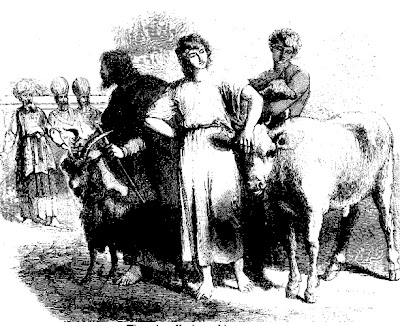
On the first sacrifice day, Aaron brought animals to pay for his sin. Moses told him how to make each type of sacrifice – the sin offering, the burnt offering, the peace or fellowship offering and the grain offering. Different animals were needed for each one. These animals had to be perfect male animals (goats, lambs, calves or oxen) from the peoples’ own flocks.
Choosing animals for sacrifice (Graphic courtesy CC-Art.com)

As Aaron and his sons brought and slaughtered the animals, the crowd watched. The sight of innocent animals dying reminded them how serious it was to disobey God.

At the end of the day, Moses and Aaron spoke a blessing on the people. Then God blessed them too – not in a peaceful way but with an awesome, fearful sign. As the people watched, God’s glory came down as fire. Bright hot flames simply appeared and consumed the animal parts still on the altar.

When the people saw it, they were happy. The fire showed that God had accepted the sacrifice. But they were also afraid. What kind of a God could send fire like this? The people fell on their faces in worship.

PRAYER: Dear God, thank You for showing us Your awesome power. Help us to know Your power too, and to respect and fear You. Amen.

MORE: God’s ‘Yes!’
After this first day of sacrifices, God said “Yes!” by sending fire. Of course God doesn’t always respond in such spectacular ways. Here are some other ways God showed the people in the Bible that He was there, right with them. Match the incident to the person who lived it (listed below). How has God sad "yes" to you?

1. God’s sent a rainbow to show He would keep a promise. (Genesis 9:11-13)
2. God sent helpers (angels) to get a family out of an evil city (Genesis 19:15)
3. God answered a prayer (Genesis 24:12-16)
4. God spoke in a dream (Genesis 28:10-17)
5. God gave a prisoner favor with the king (Genesis 41:39,40)

A. Abraham’s servant
B. Lot
C. Jacob
D. Noah
E. Joseph.

Answers

*********
Unless otherwise noted, all Scripture quotations are taken from THE HOLY BIBLE, NEW INTERNATIONAL VERSION®, NIV® Copyright © 1973, 1978, 1984, 2011 by Biblica, Inc.® Used by permission. All rights reserved worldwide.


Adult readers - DAILY DEVOTIONS FOR ADULTS  are available too at Other Food: daily devo's

Wednesday, March 8, 2017

Blood Sacrifice

TODAY’S SPECIAL: Leviticus 17:11

TO CHEW ON: "For the life of a creature is in the blood, and I have given it to you to make atonement for yourselves on the altar; it is the blood that makes atonement for one’s life." Leviticus 17:11

Moses had been up on the mountain with God for a long time and God had told him many things. One of the things God gold Moses was a way to deal with sin.

What is sin? It is missing the target. If we think of doing everything God has said we should do, and not doing anything God has said we shouldn't do as the target, sin is missing that target.

Target with arrows

For example, when God told Adam and Eve not to eat of the special tree in the garden and they did – that was sin. And when God told the people they were not to worship any other God but Him and they made a calf idol and worshiped it – that was sin. God gave the people a list of rules (we call them the Ten Commandments) which told them what was sin for each area of life, from how they treated parents and neighbors to how they treated God. The trouble was, no one could keep all these rules.

The punishment for breaking these rules – even one of them – was death. Period.

But on the mountain, God told Moses that He would make a way for the people to come back into His good favor – make atonement. It was a way they didn’t have to take the punishment of death themselves. They could substitute the blood of an animal. The blood would show that the animal had died (for no living thing, human or animal, can live without blood going through its body). The blood showed that the death penalty had been paid – for now. God accepted as a temporary punishment for sin, the death of an animal instead of the death of the sinful person.

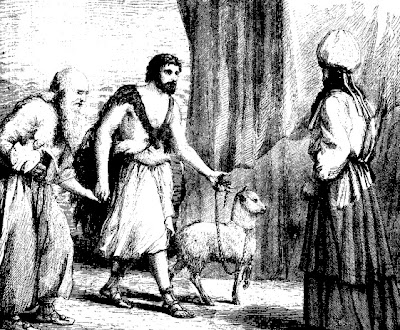
Bringing the lamb as an offering
Bringing the lamb as an offering - Picture from CC-Art.com


PRAYER: Dear God, thank You for making a way for people to be right with You – through animal sacrifices, and then through Jesus. Amen.


MORE:  Sin’s Wages
God’s punishment for sin hasn’t changed. Paul, in the New Testament book of Romans calls this punishment ‘wages.’ Those wages are still death. Every one of us earns these wages every time we sin. But Someone – not an animal – took the punishment of death for the sins each one of us has committed.
1. Who was that Someone? (I Corinthians 15:3) ____________
2. What penalty did He pay? _____________

Here is a verse to memorize. It will remind you of sin’s wages and God’s gift to us through Jesus:

For the wages of sin is death, but the gift of God is eternal life in Christ Jesus our Lord.
- Romans 6:23


Answers


***********
Unless otherwise noted, all Scripture quotations are taken from THE HOLY BIBLE, NEW INTERNATIONAL VERSION®, NIV® Copyright © 1973, 1978, 1984, 2011 by Biblica, Inc.® Used by permission. All rights reserved worldwide.

Adult readers - DAILY DEVOTIONS FOR ADULTS  are available too at Other Food: daily devo's